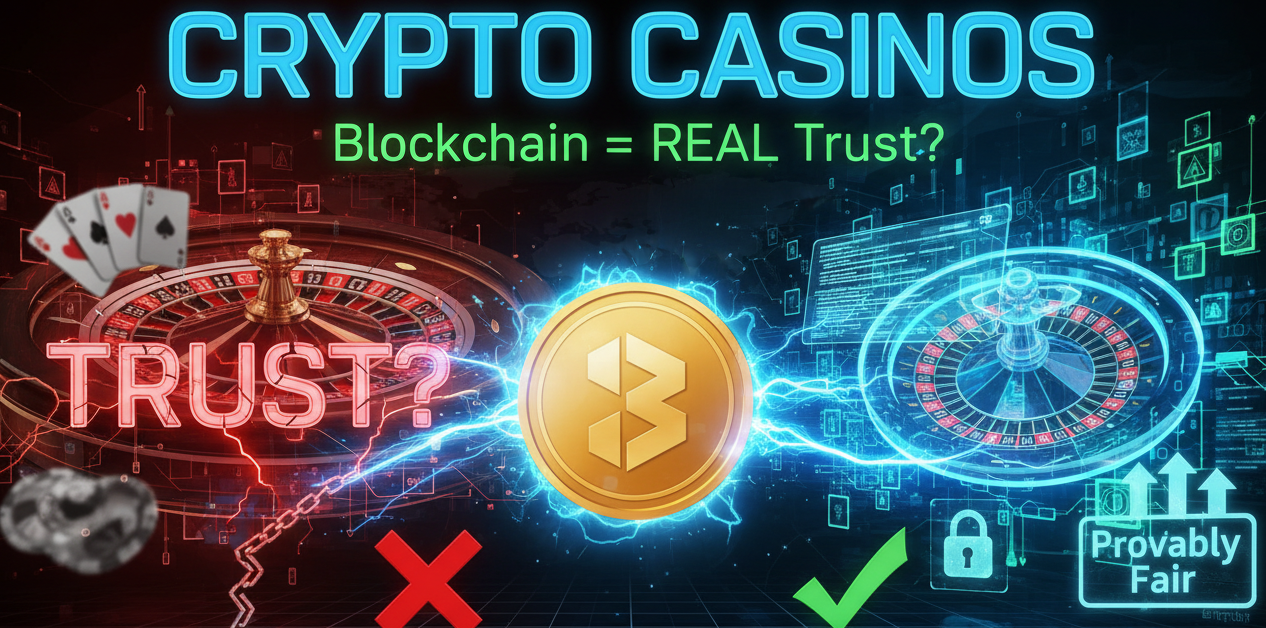
Online gambling has always relied on one fragile element — trust.
Players deposit real money into systems they cannot inspect, accept that games are fair, and hope payouts arrive without friction. Even when operators act responsibly, the experience often feels like stepping into a black box: you click, you play, and you believe everything works as promised.
Crypto casinos emerged as an answer to that problem. What began as a niche corner of the Bitcoin community has grown into a serious segment of the gambling industry, driven by one simple idea: don’t ask players to trust — let them verify.
In 2025, that idea is shaping the next этап evolution of online casinos.
Why Crypto Casinos Appeared at All
The rise of crypto casinos didn’t happen in isolation. It emerged at the intersection of two long-term trends: growing distrust toward centralized platforms and the global shift toward digital assets as payment tools.
Over the past decade, players have become more sensitive to issues like delayed withdrawals, payment freezes, or sudden account verification requests. At the same time, the growth of blockchain technology introduced a new expectation — if financial systems can be transparent and programmable, why shouldn’t gambling platforms work the same way?
Crypto casinos didn’t reinvent online gambling. Instead, they applied fintech principles — speed, ownership, transparency — to an industry where trust has always been fragile.
From Reputation-Based Trust to Mathematical Proof
Traditional online casinos rely heavily on licensing, audits, and reputation to convince players that games are fair. Most legitimate operators follow strict standards — but for the average user, fairness still feels invisible.
Blockchain-based casinos introduced a different approach through provably fair technology.
Instead of hiding game logic behind closed systems, outcomes can be verified after each round. Players receive cryptographic data (server seeds and hashes) that allows them to confirm that results were generated exactly as promised — not altered retroactively or influenced by the house.
For experienced players, this changes the psychology of gambling. Winning or losing becomes less about questioning the system and more about accepting randomness itself.
That subtle shift in perception is one of the reasons crypto casinos have gained momentum so quickly.
Speed Became a Competitive Advantage
Trust alone wasn’t enough to drive adoption. Speed played an equally important role.
Early bitcoin casino platforms struggled with transaction times. Waiting for blockchain confirmations worked for long-term investing — but not for fast-paced gaming sessions.
The rise of the Lightning Network changed expectations almost overnight. Instant, low-fee Bitcoin transfers created a smoother user experience:
- deposits appear within seconds
- withdrawals feel closer to fintech apps than traditional casinos
- micro-betting becomes practical
Interestingly, this also changed player behaviour. Shorter sessions, smaller stakes, and faster gameplay cycles became more common — especially among mobile users who treat gaming as quick entertainment rather than long sessions.
Global Access — But Not Without Context
One of the biggest appeals of crypto casinos is accessibility. Players who face banking restrictions, slow international transfers, or privacy concerns often find crypto payments easier to manage.
At the same time, the industry has matured enough to acknowledge an important reality: blockchain doesn’t exist outside regulation. Responsible crypto casinos increasingly emphasize compliance and local rules, understanding that long-term growth depends on legitimacy rather than loopholes.
Where crypto does offer a real advantage is financial privacy. Users transact through wallets rather than exposing sensitive card or banking details — a factor that resonates strongly after years of data breaches across online platforms.
The GameFi Influence: When Playing Turns Into Participation
Another notable trend is the overlap between gambling and Web3 ecosystems.
Some crypto casinos are experimenting with NFT-based loyalty models where rewards hold transferable value. Others explore staking mechanics or community-driven bonuses, allowing players to feel partially involved in the ecosystem rather than being purely customers.
Not every experiment succeeds — and many ideas remain experimental — but the direction reflects a broader shift in player expectations. Modern users want interaction, ownership, and flexibility, not just static bonus points.
Platforms Moving Beyond the Crypto Hype
As the market matures, the most successful platforms are no longer those that simply accept Bitcoin, but those that make blockchain benefits feel natural to everyday players.
LevelUp Casino is one example of this new generation. By supporting multiple cryptocurrencies such as Bitcoin, Ethereum, and Litecoin while maintaining a clean, traditional casino UX, it removes much of the friction that previously discouraged mainstream users from trying crypto gambling.
Fast withdrawals, intuitive navigation, and a strong game selection show how blockchain features can enhance the experience without turning it into a technical learning curve.
That balance — innovation without complexity — is becoming a key competitive advantage.
The Other Side of the Story
Despite strong growth, crypto casinos are not a flawless solution.
Players take greater responsibility for wallet security. Transactions are often irreversible, which makes mistakes more costly than traditional payment methods. Price volatility can also affect the real value of wins or losses.
Regulation remains another moving target. Different countries continue to define their positions on crypto gambling, and responsible players are learning to pay closer attention to licensing and operator transparency.
In other words, crypto casinos improve trust mechanisms — but they don’t remove risk entirely.
Where the Industry Is Heading
Crypto casinos are unlikely to replace traditional online gambling overnight. Instead, they are quietly reshaping expectations.
Players now expect:
- faster payouts
- clearer fairness mechanisms
- more control over funds
- greater transparency from operators
Even traditional casinos are beginning to adopt ideas that originated in the crypto space — proof that the shift is influencing the broader industry.
Ultimately, blockchain doesn’t change the nature of gambling itself. The risks and excitement remain the same. What it changes is the relationship between players and platforms.
And in an industry built on trust, that may be the most important innovation of all.
Crypto Casinos – How Blockchain Is Redefining Trust in Online Gambling